Okutsumiya: The Turtle Is Looking at You
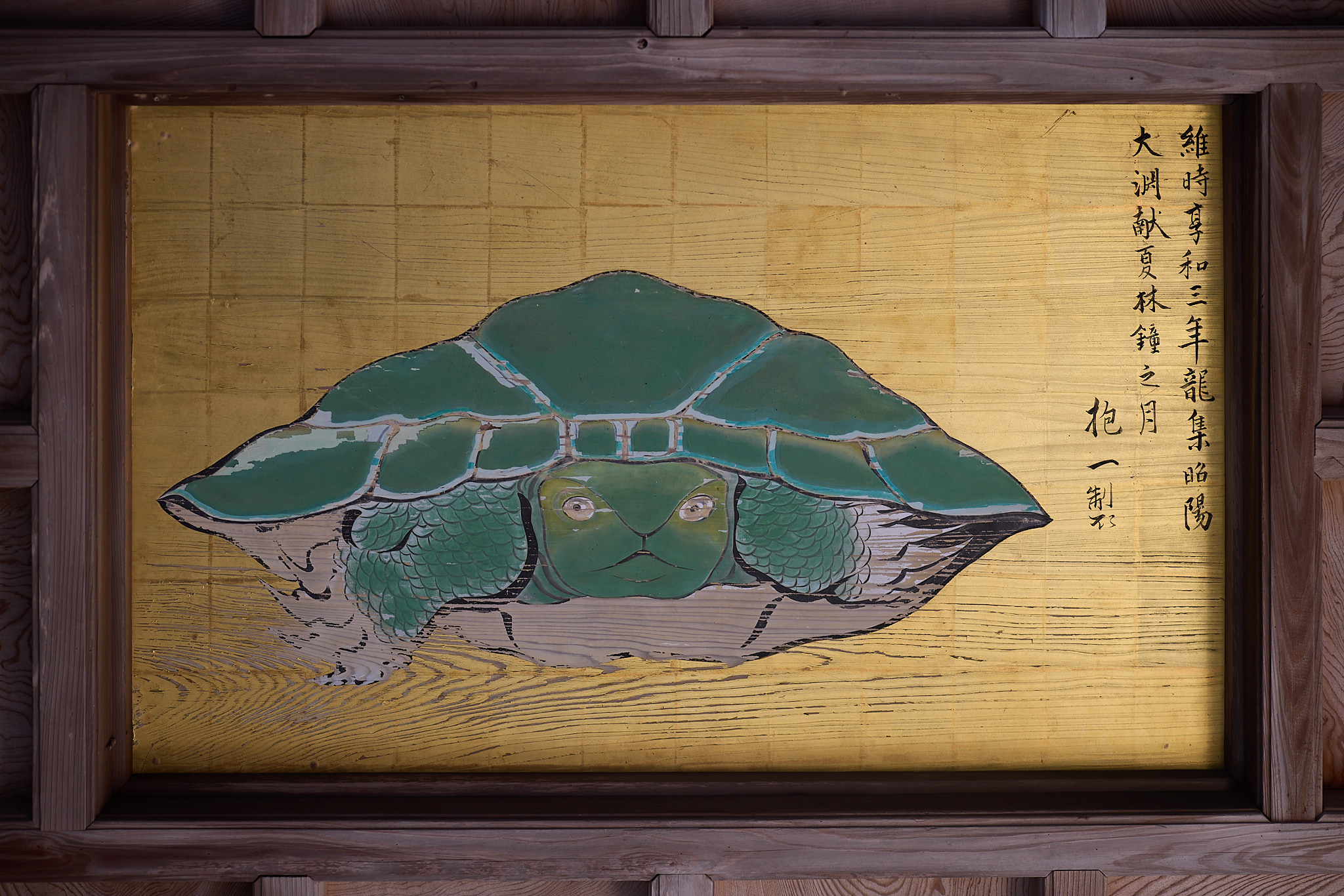
The turtle in the photo above is looking at you. If you lean to one side, it will go on looking at you. I tried this in person, from several places, and it kept up.
It lives on the ceiling of the worship hall at Okutsumiya, the farthest of the three shrines that make up Enoshima Shrine, on a small island off the coast of Kanagawa Prefecture, south of Tokyo. The goddess enshrined here today is Tagirihime, the eldest of three sisters; the other two have the other two shrines. In the old days, this was also where the deity of the island’s sea caves was carried up the hill for the summer, when the sea came in.
Eyes on the ceiling
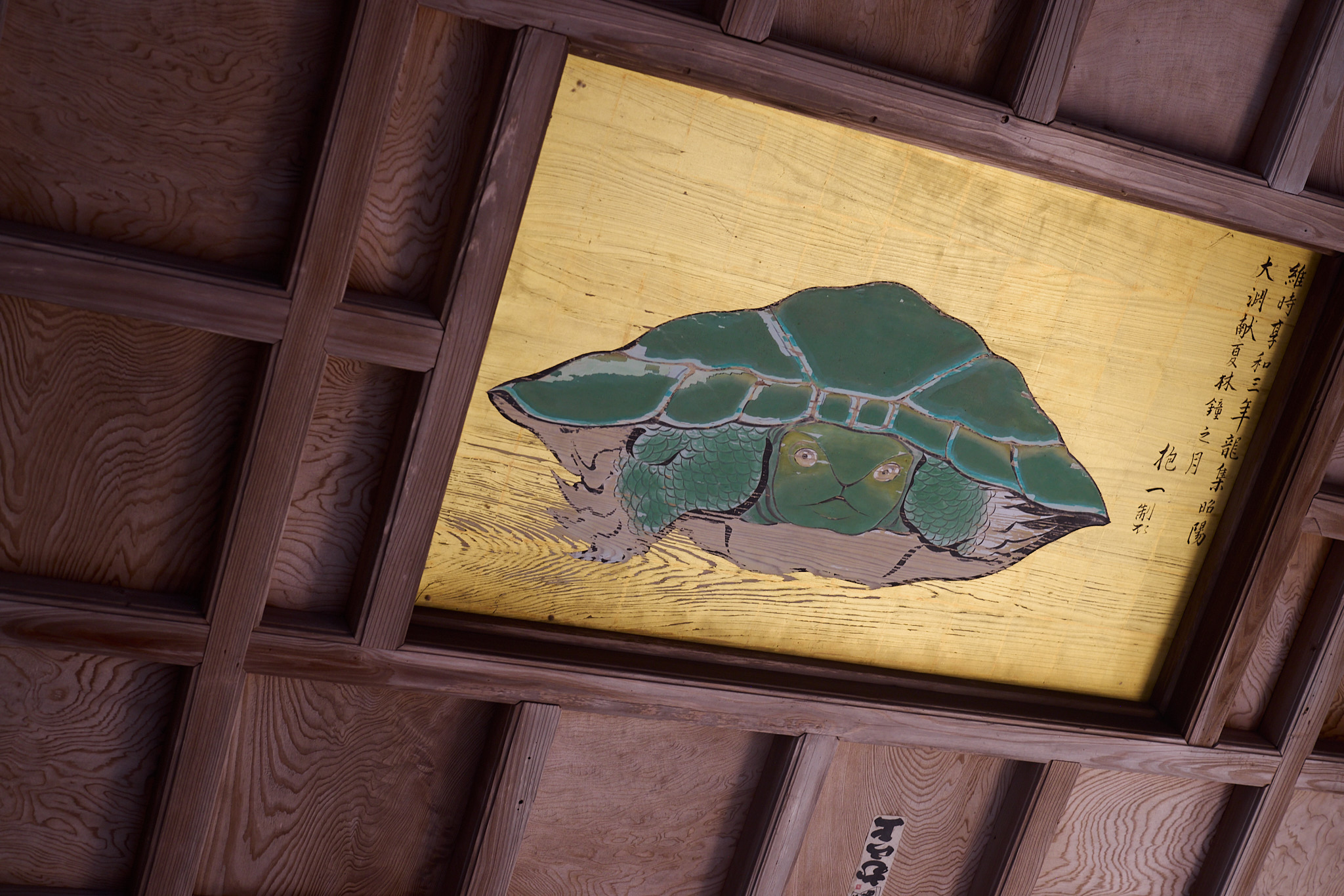
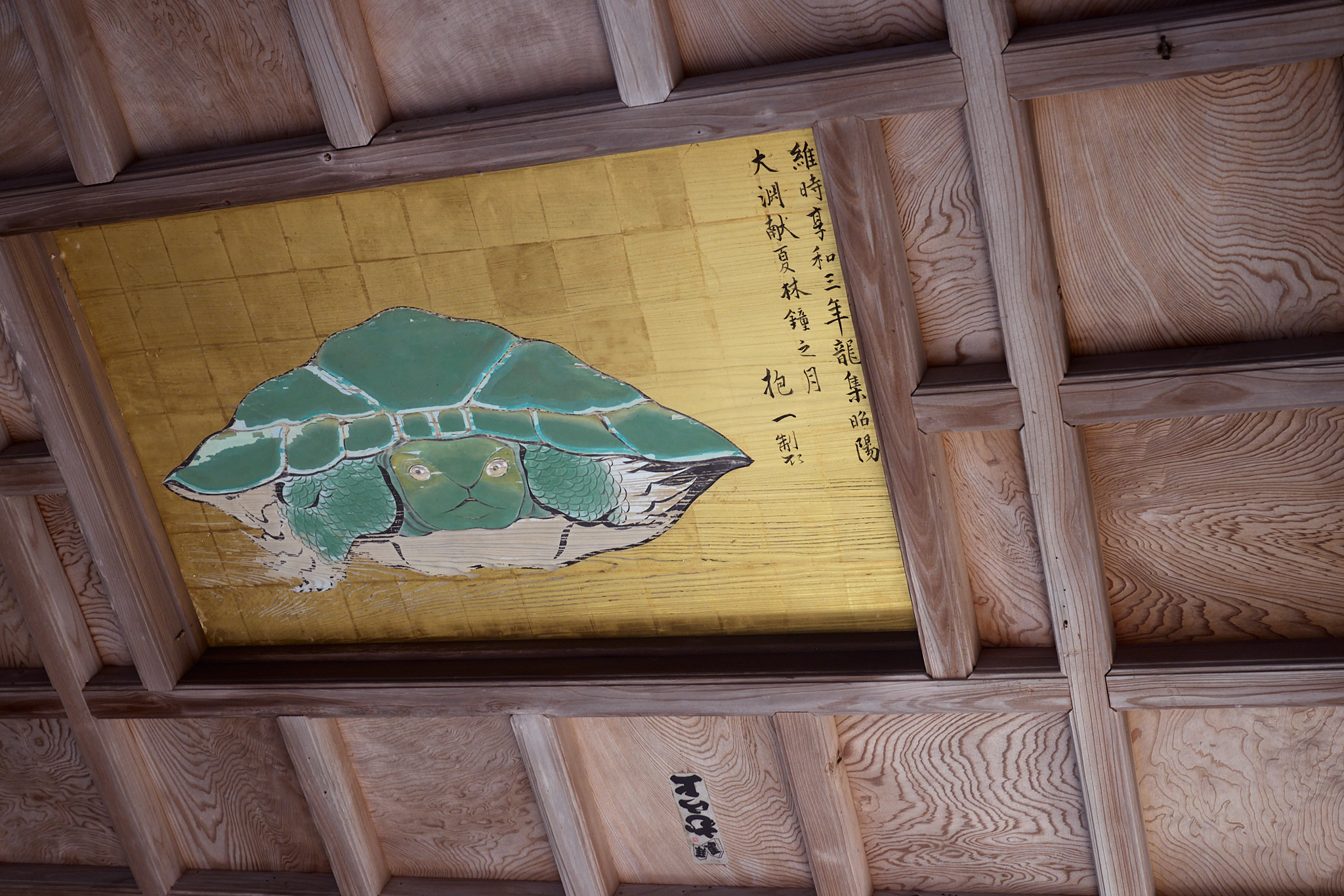
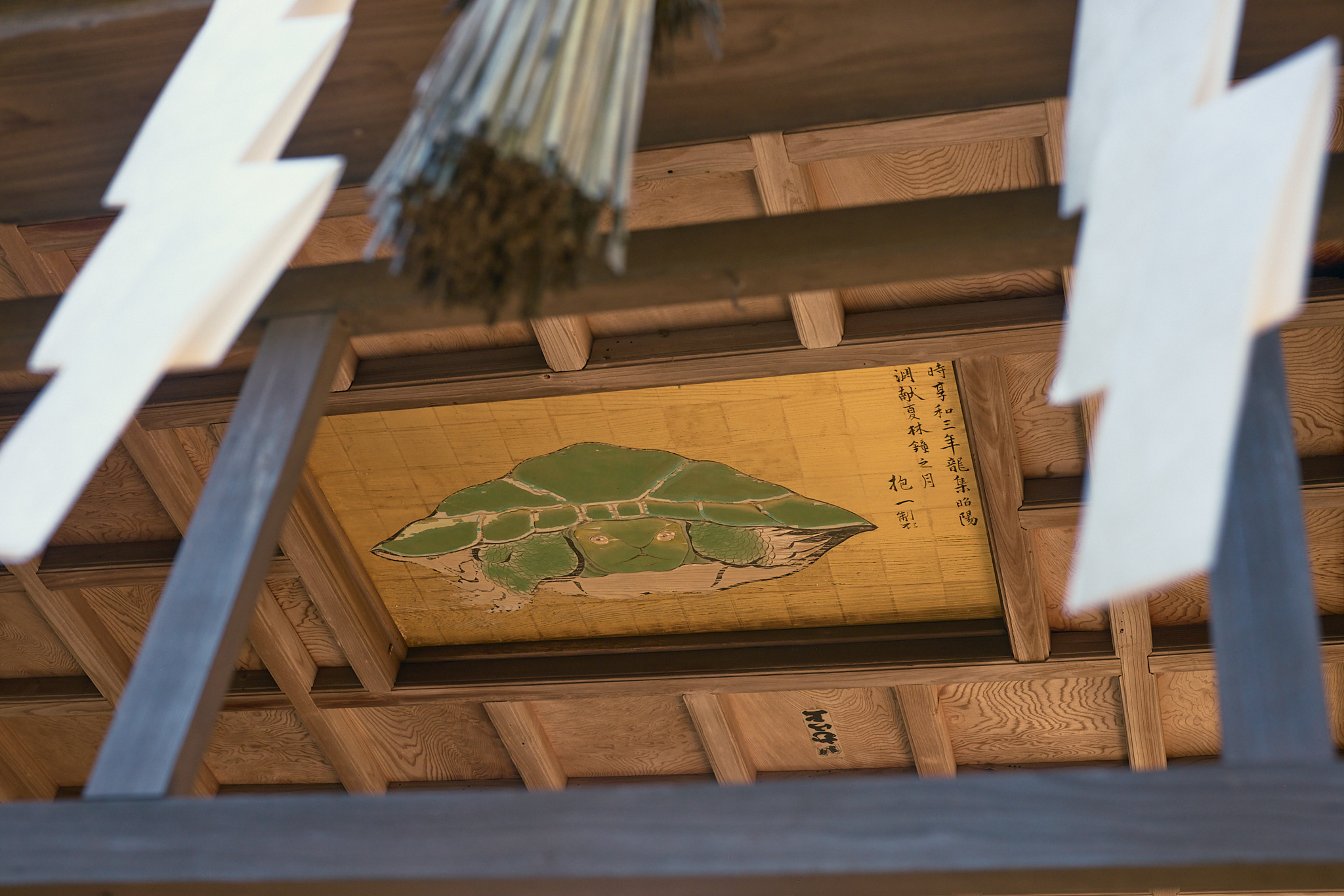
The painting fills one square of a coffered ceiling. A green shell spreads wide over gold leaf, scaly legs splay out on either side, and in the middle is a face pointed straight down at whoever is standing underneath. It is known as the Happō-nirami no Kame: the turtle that glares in all eight directions.
A face painted looking straight out of a flat picture still reads as one turned toward you, even from an angle. Photograph it from the side without the ceiling in the shot, though, and nobody will believe you moved.
So here is the ceiling.
Swipe to explore
Tap to enlarge
Signed and dated
To the right of the turtle, a few lines of ink give a date in the summer of 1803 and a signature: Hōitsu.
Sakai Hōitsu was the younger brother of the lord of Himeji, a writer of haikai and comic verse as well as a painter. In later life he devoted himself to the work of an earlier master, Ogata Kōrin, whose style he carried on in Edo.
The years and the sea air were hard on his gold leaf. The original is now kept in the shrine’s treasure house, having done its share of watching. The turtle on the ceiling is a copy, painted by Kataoka Kayō in 1994.
Paddles and dragons
Inside the hall, two giant wooden rice paddles stand on either side of the view through to the sanctuary behind.
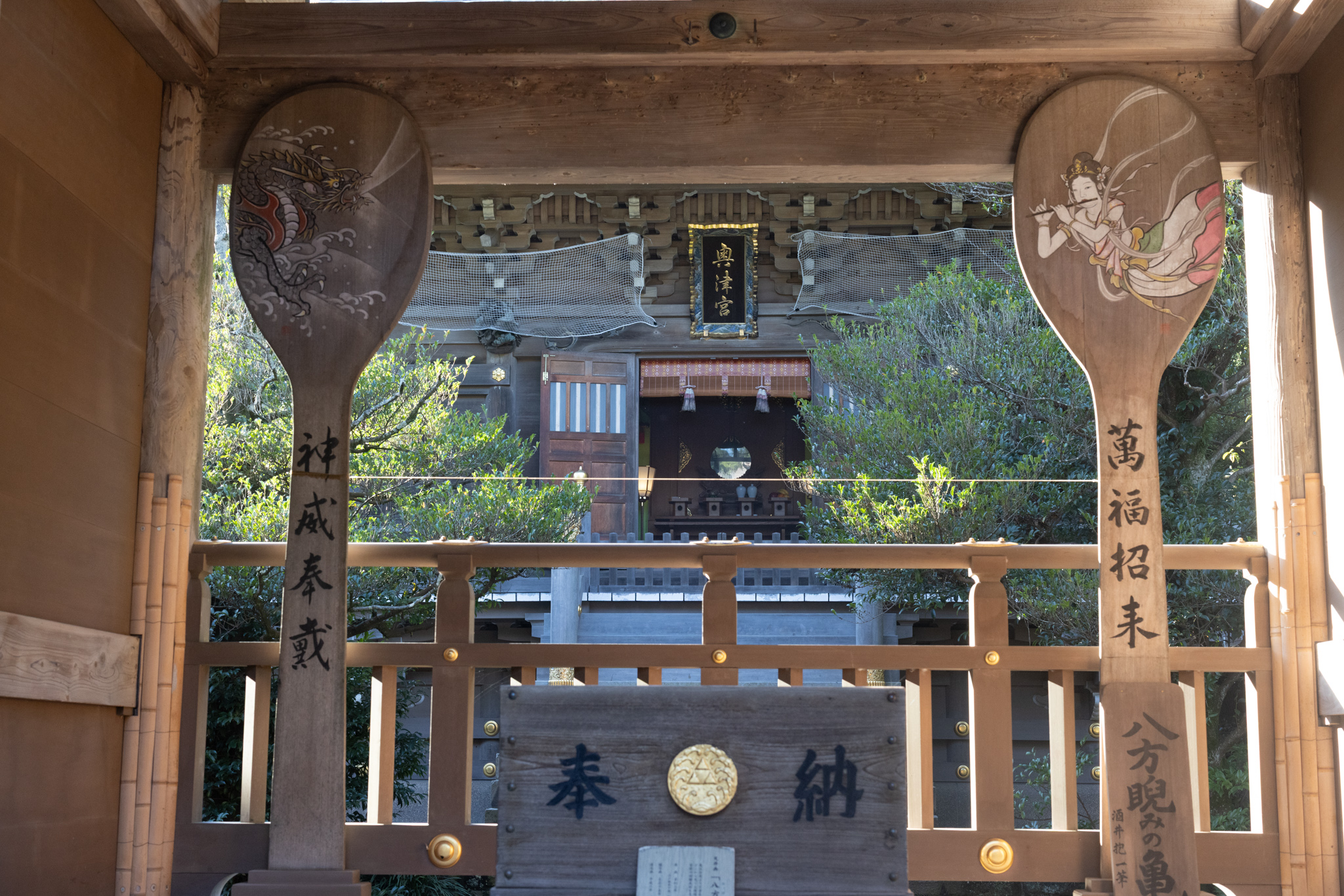
On the left-hand paddle, a dragon rides the waves above the words 神威奉戴, roughly “Receiving the power of the gods.” On the right, a heavenly maiden floats above 萬福招来, “Inviting every kind of good fortune.” The paddles are said to be shaped a little like a biwa, a kind of lute. The maiden has brought a flute.
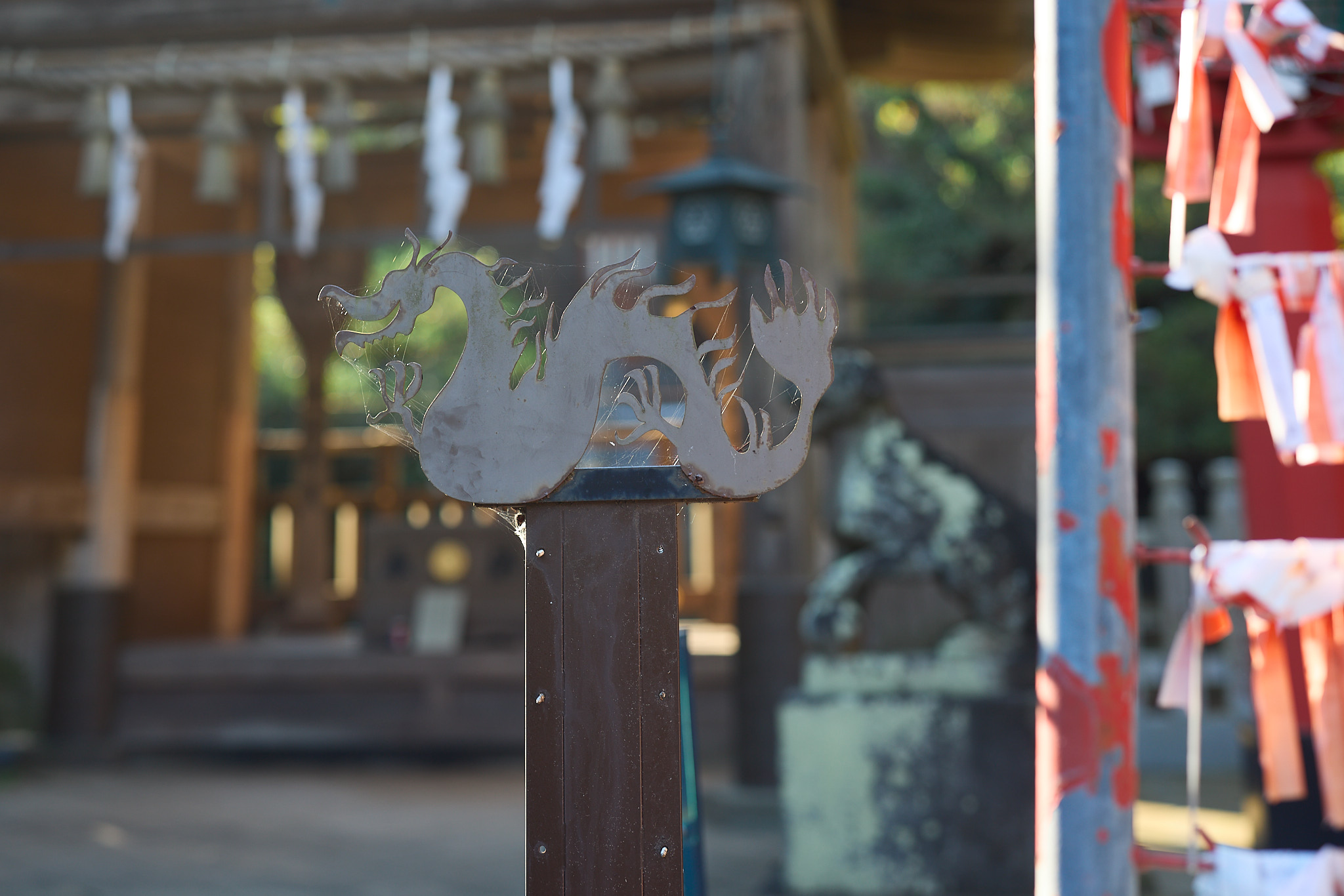
Dragons are not hard to find around here. Outside, one sits on top of a post, cut out of sheet metal.
Two stones on one path
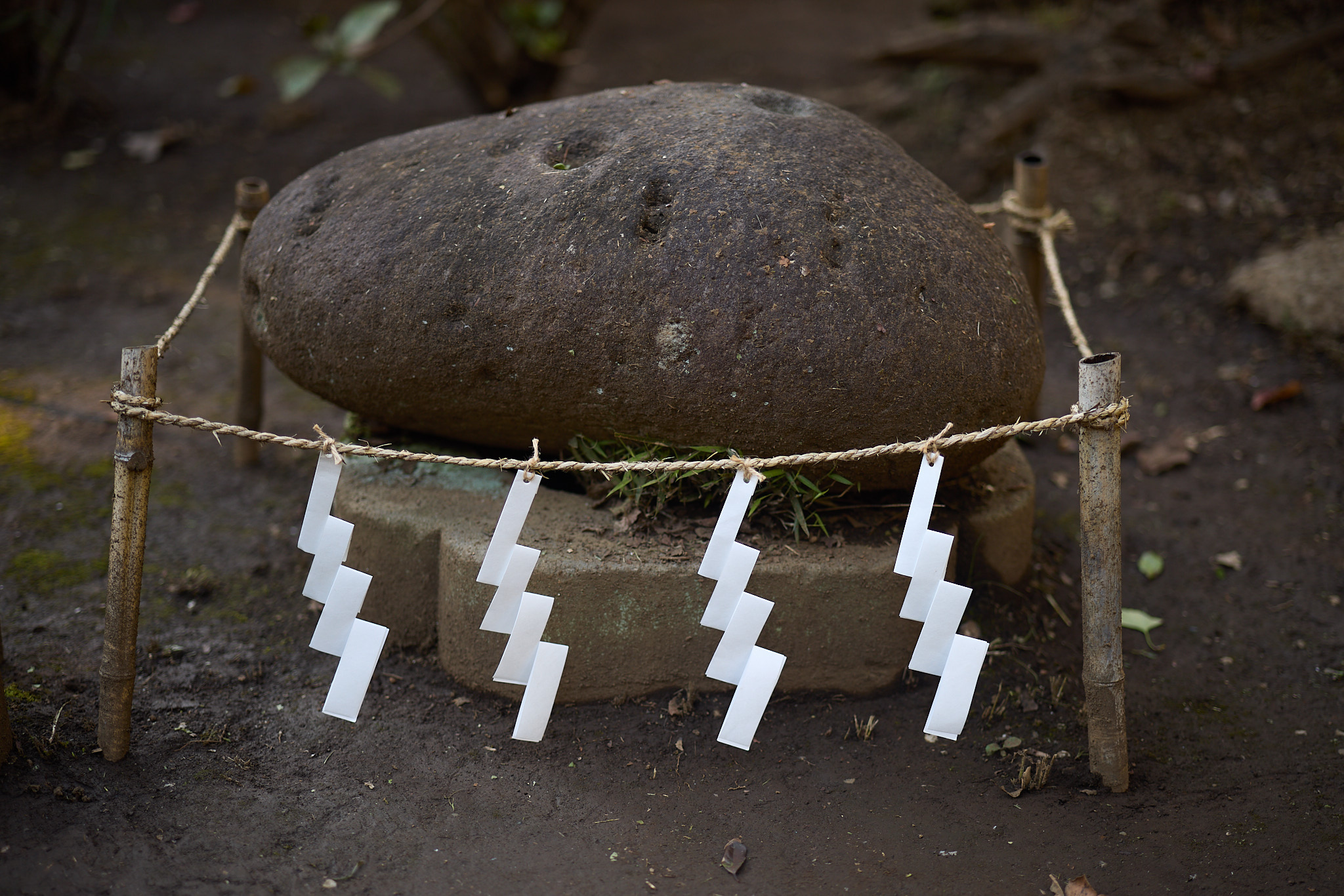
Out in the grounds, on the left of a path, sits a plain, round boulder. Its inscription names the man who offered it, Unosuke, and gives its weight: eighty kan, an old unit, or about 300 kilograms. Unosuke was a strongman, called in his day the strongest man in Japan. He toured the country lifting things, and in 1833 he performed before the shogun. This stone is thought to come from a show of strength in front of the crowds at a festival for Benzaiten, the goddess long worshipped on the island.
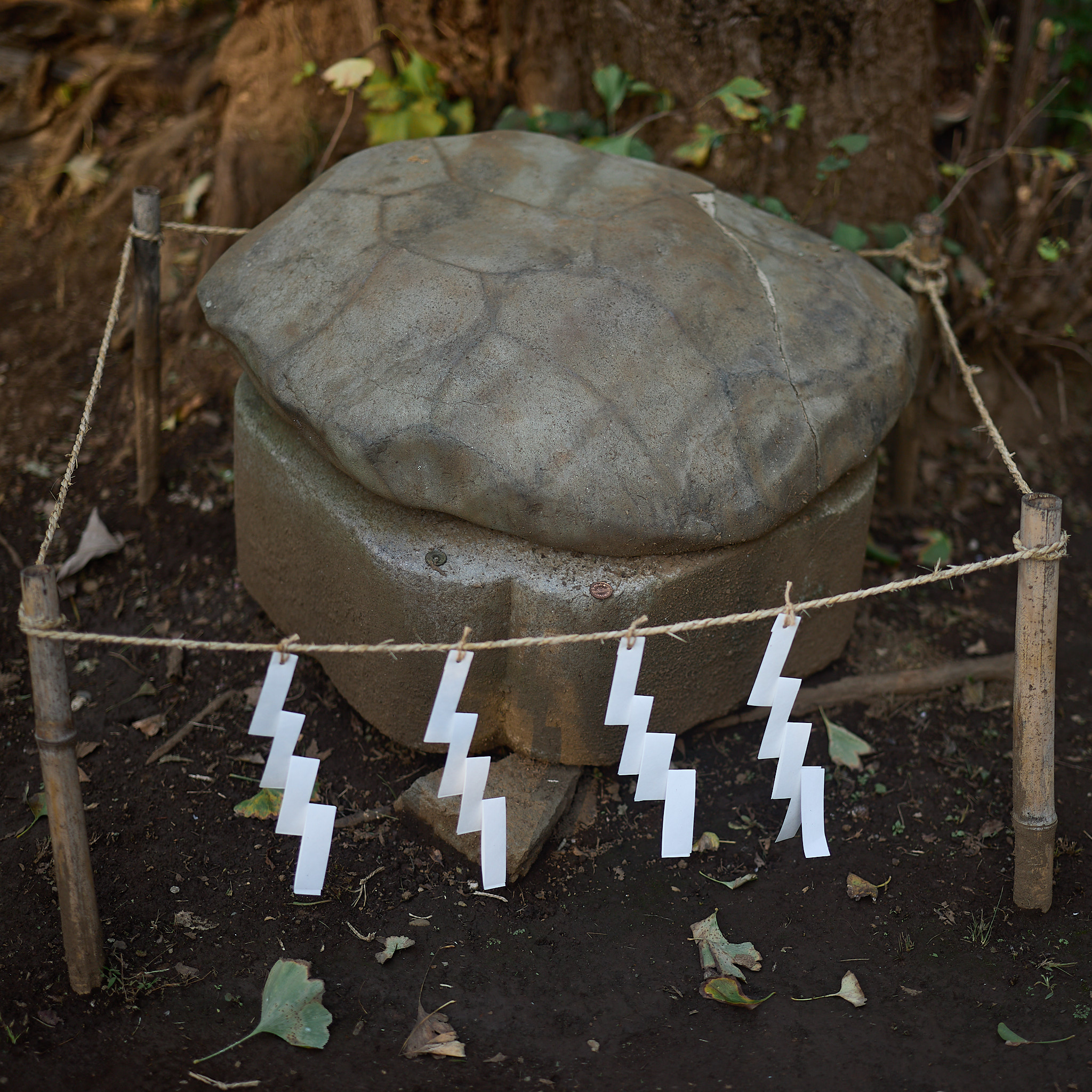
A little farther on is a stone with a pattern of plates across its top, like a shell. It is called the Kikkō-ishi, the tortoiseshell stone.
How it got here is said to be recorded in a chronicle of events in Edo. In 1806, a devotee of Benzaiten copied out a sutra and wanted to lay it to rest somewhere pure, with a stone on top. Looking for a suitable one, he came across a stone shaped like a turtle, and gave it to Enoshima.
The musician and the mould
A little way off, a bronze figure in a hood sits among the trees with a fan in his hand.
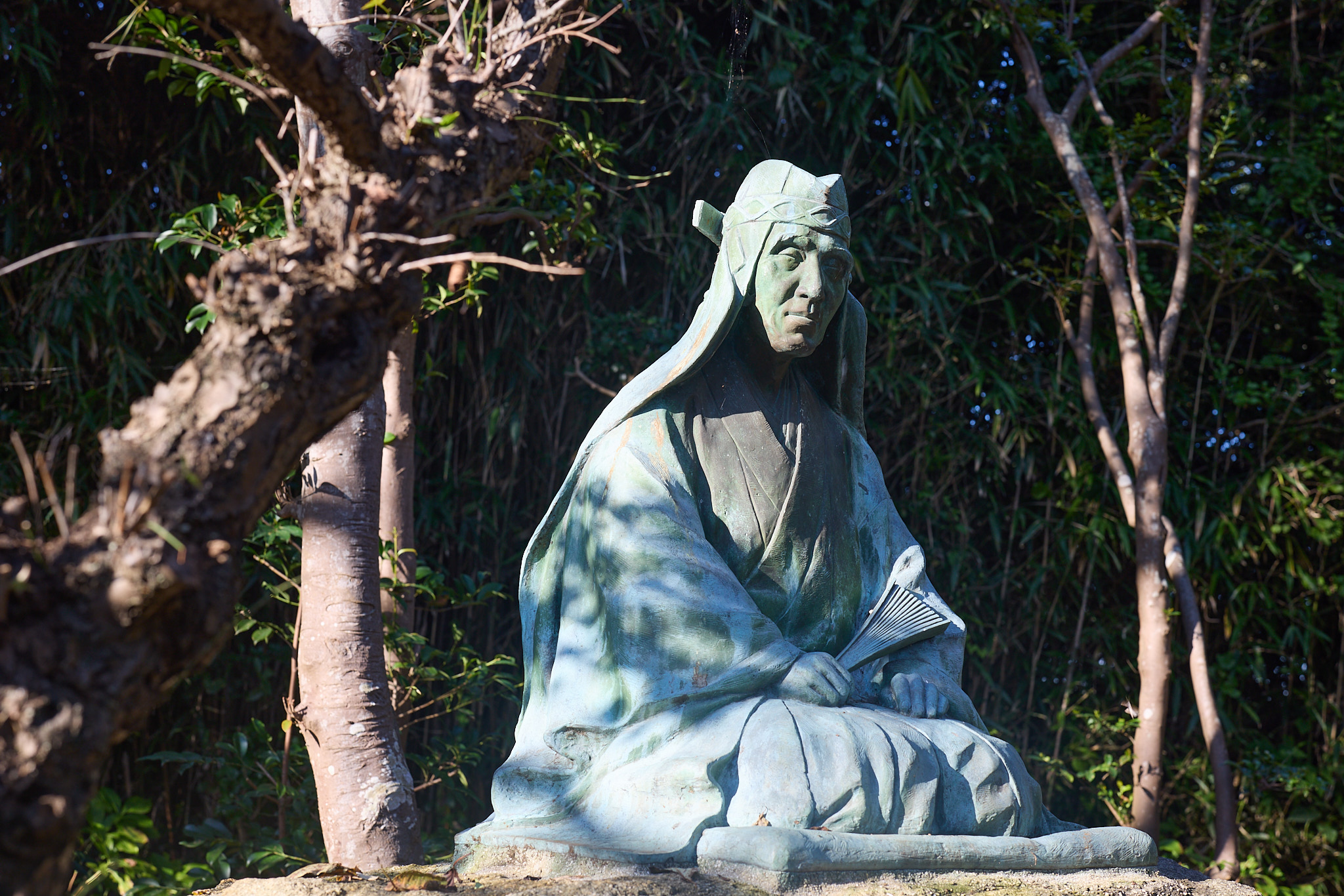
This is Yamada Kengyō, founder of the Yamada school of koto music. Kengyō was not his name but his rank, the highest in the old guild of blind men, many of whom made their living as musicians. He had lost his sight as a child. He brought the storytelling melodies of the puppet theatre into music for the koto, and one of his best-known pieces, Enoshima no Kyoku, is said to have been written during a stay on the island.
His statue went up here in 1917. During the Second World War, it was given up for its metal. The mould was not, and when it turned up years later, the Yamada school’s association cast him again. He took his seat for the second time in 2004.
The lanterns
Beside the hall stands a pair of stone lanterns, given in 1846 by a man from a village in Tama, west of Edo. They are carved almost all over: dragons, a bird and, on the bases, whole scenes with people in them.
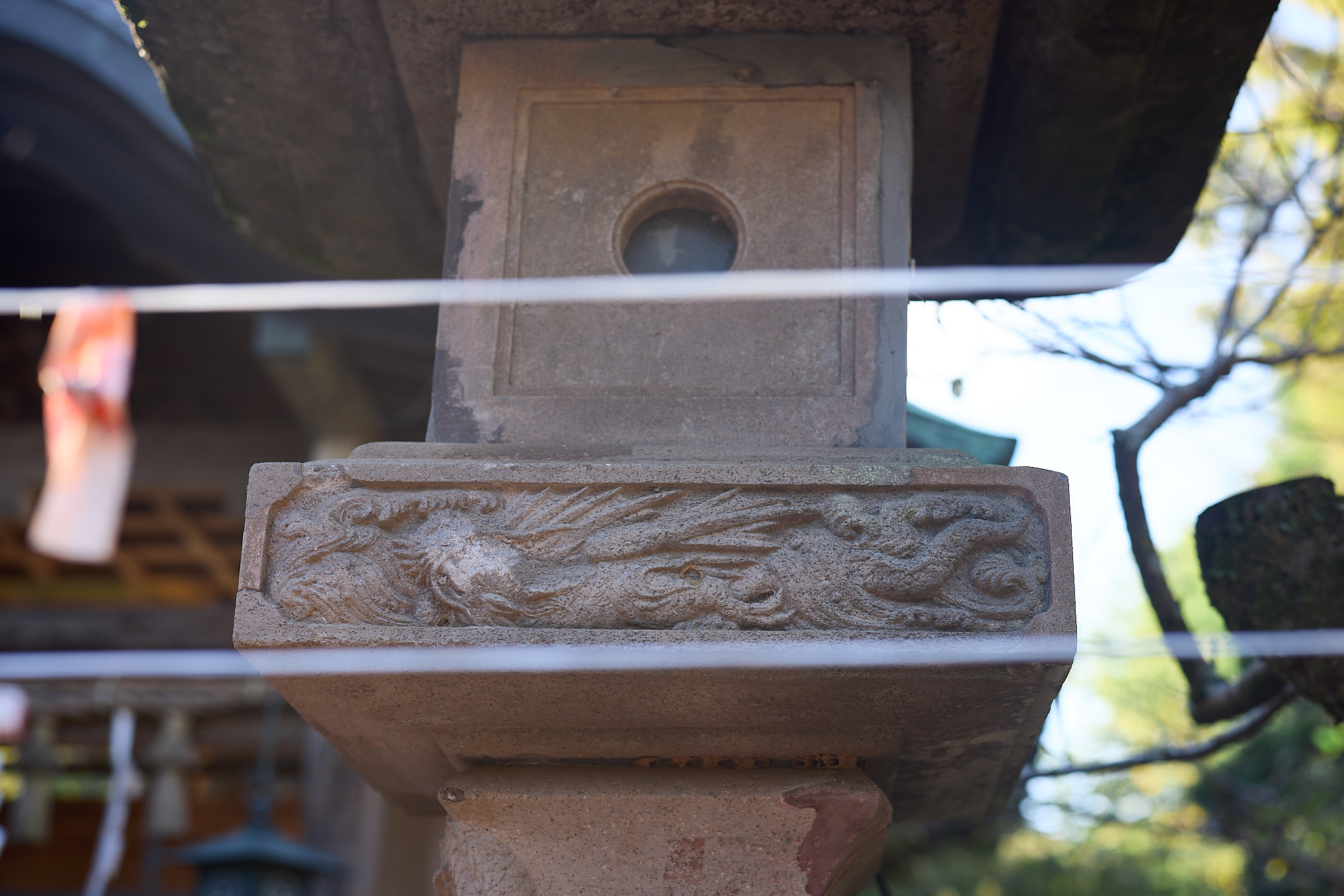
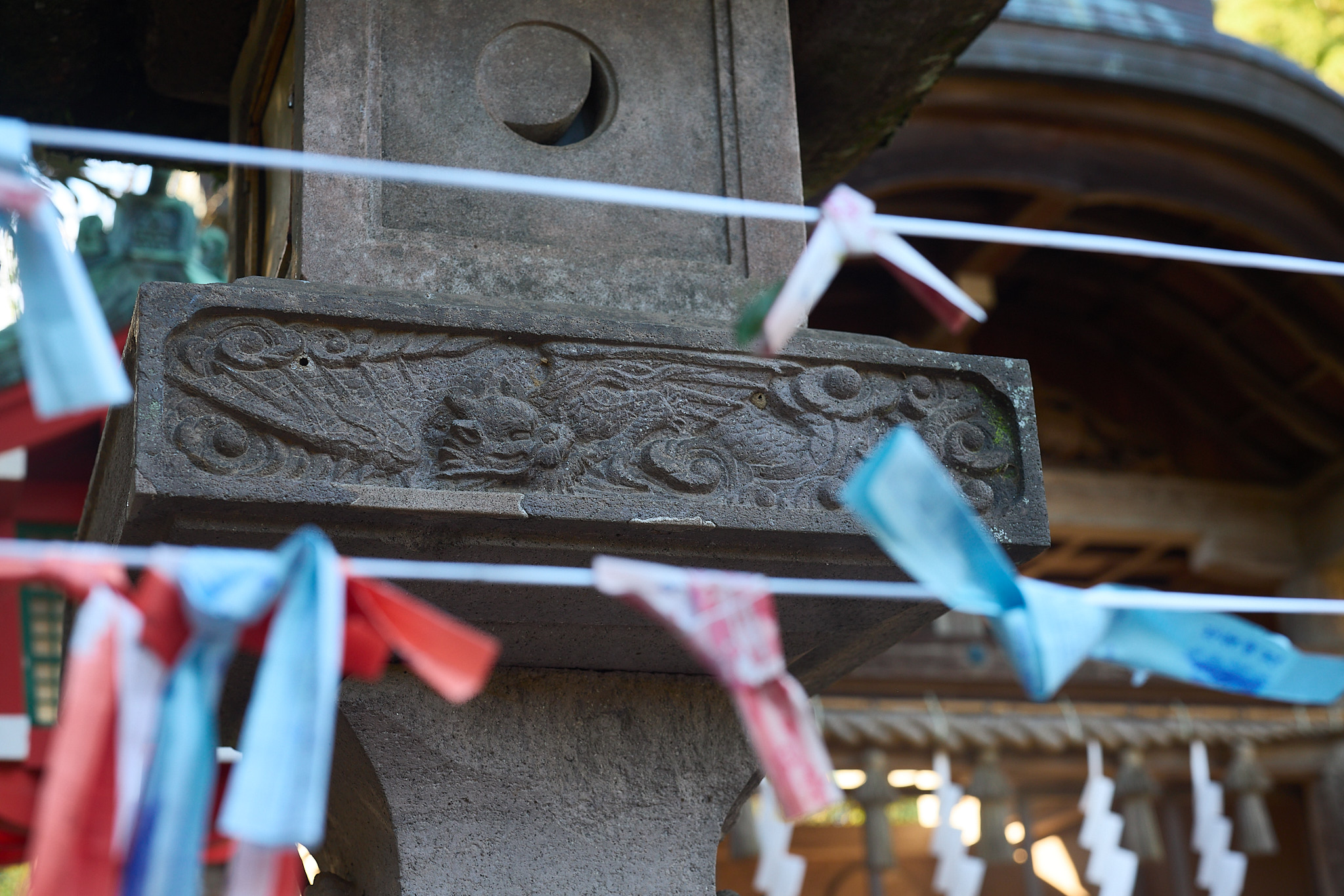
The lantern on the right as you face Okutsumiya shows Otohime, princess of the Dragon Palace under the sea. The one on the left shows Urashima Tarō, the fisherman of the folk tale, riding there on the back of a turtle.
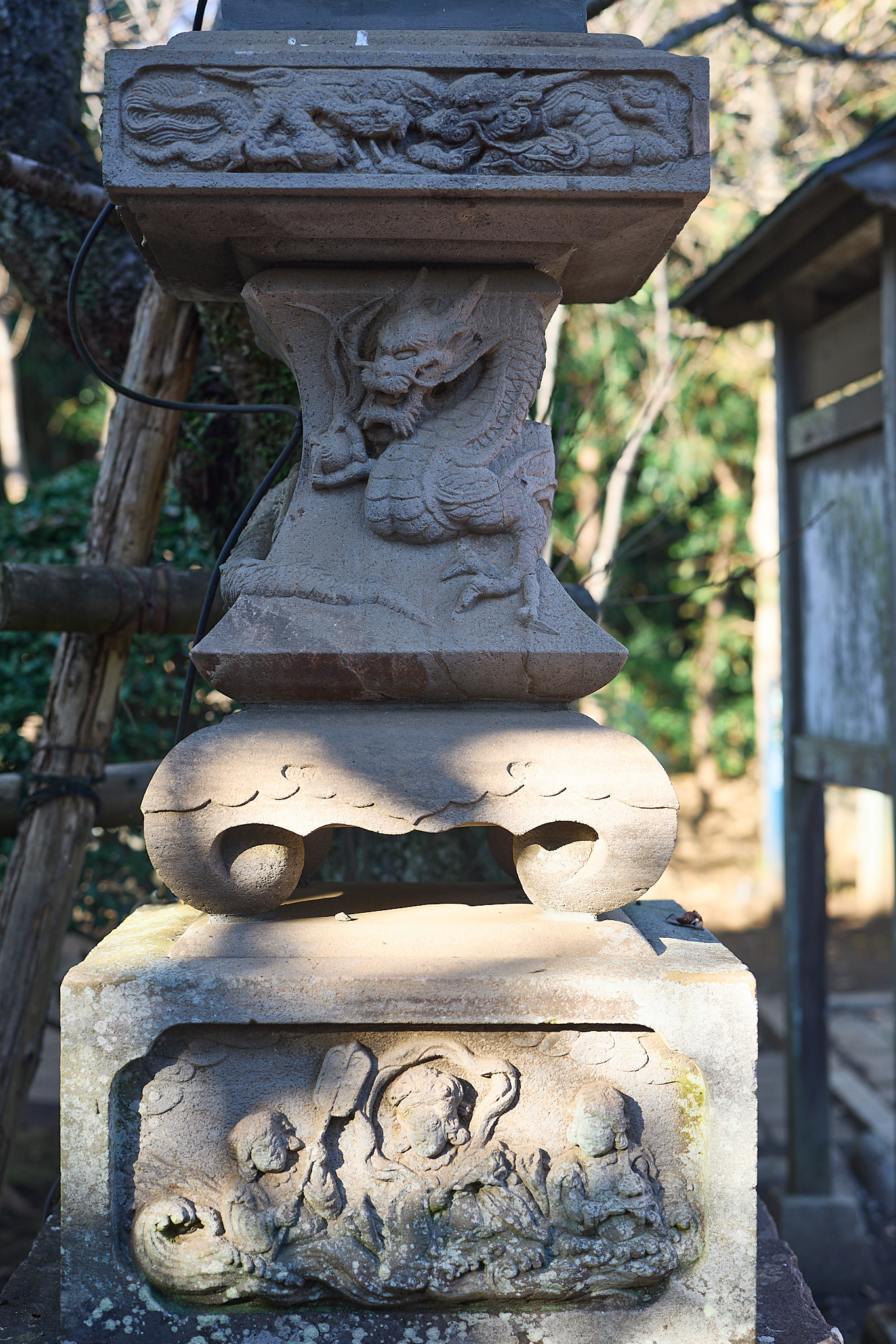
On one base, a woman with elaborately dressed hair crosses the waves with her attendants, one of them holding up a fan.
On the other, the scene has gone under lichen and moss. There is a figure in the middle, and not much else to make out.
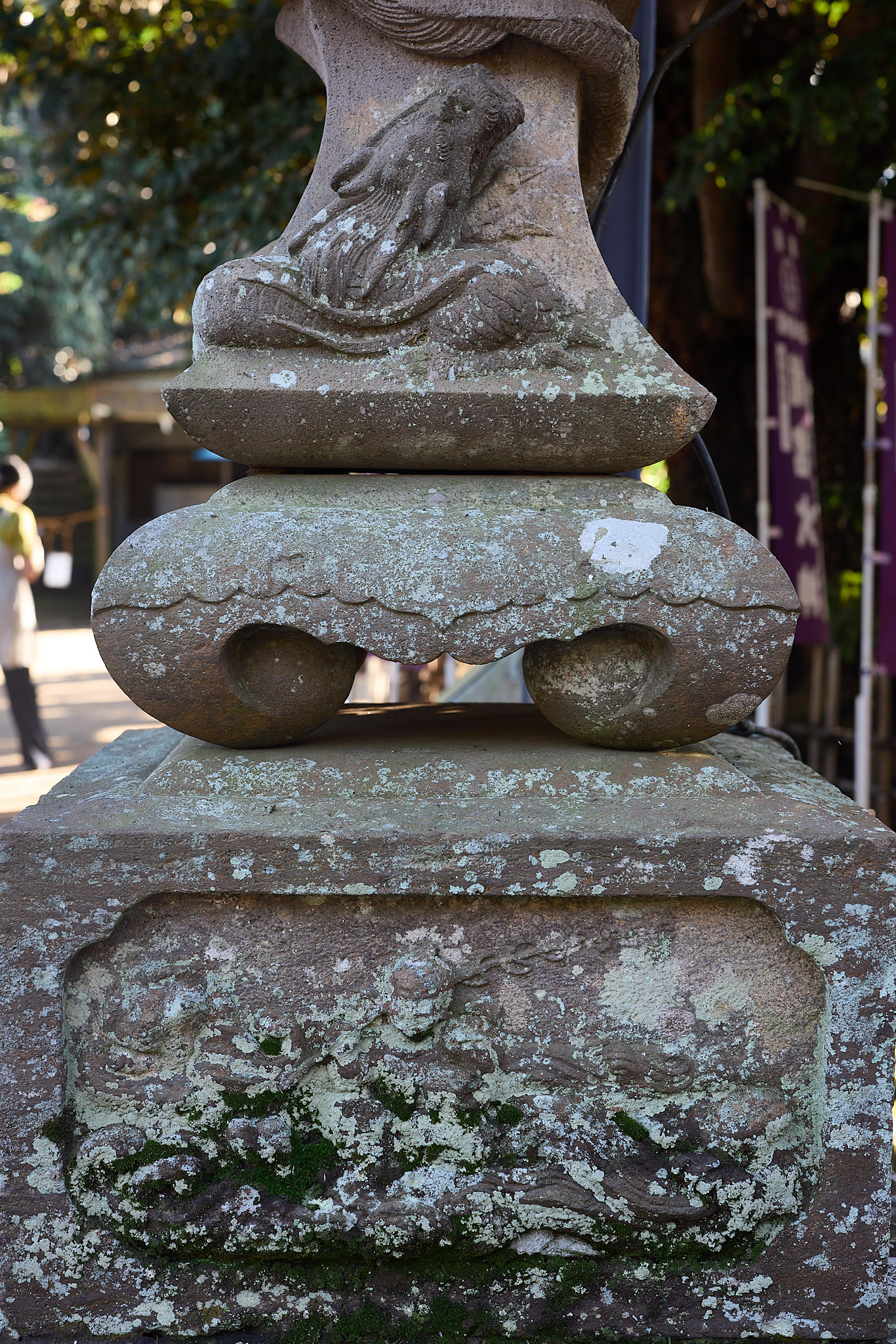
If Urashima’s turtle is under there somewhere, it has stopped looking at anyone.
Visit this place
Location
Okutsumiya, Enoshima Shrine (江島神社 奥津宮)
Near the far end of Enoshima, the last of Enoshima Shrine’s three shrines on the way across the island, beside Wadatsumi-no-miya.
2-6-15 Enoshima, Fujisawa, Kanagawa 251-0036, Japan
Practical Information
- Area
- Enoshima, Fujisawa, Kanagawa
- Access
- About 23 minutes on foot from Katase-Enoshima Station (Odakyu Enoshima Line). The route crosses the island and includes stairs.
- Opening hours
- Open at all times
- Admission
- Free
- Visitor note
- The turtle is on the ceiling of the worship hall; stand under it and move from side to side. Wadatsumi-no-miya is next door.
- Tourism information
- Fujisawa City Tourism Association — Enoshima Shrine (Okutsumiya) (Japanese)
Information last checked: October 17, 2026 (location, access time from Katase-Enoshima Station, opening hours and admission).
Conversation
Comments
Review pending commentsComments are reviewed before appearing. The internet already contains enough unattended surprises.
Checking comments…
Comments are not available in this migration preview yet. Existing comments remain on the current site.
Leave a comment