The Tama River’s Lonely Lion: The Last King in the Grass
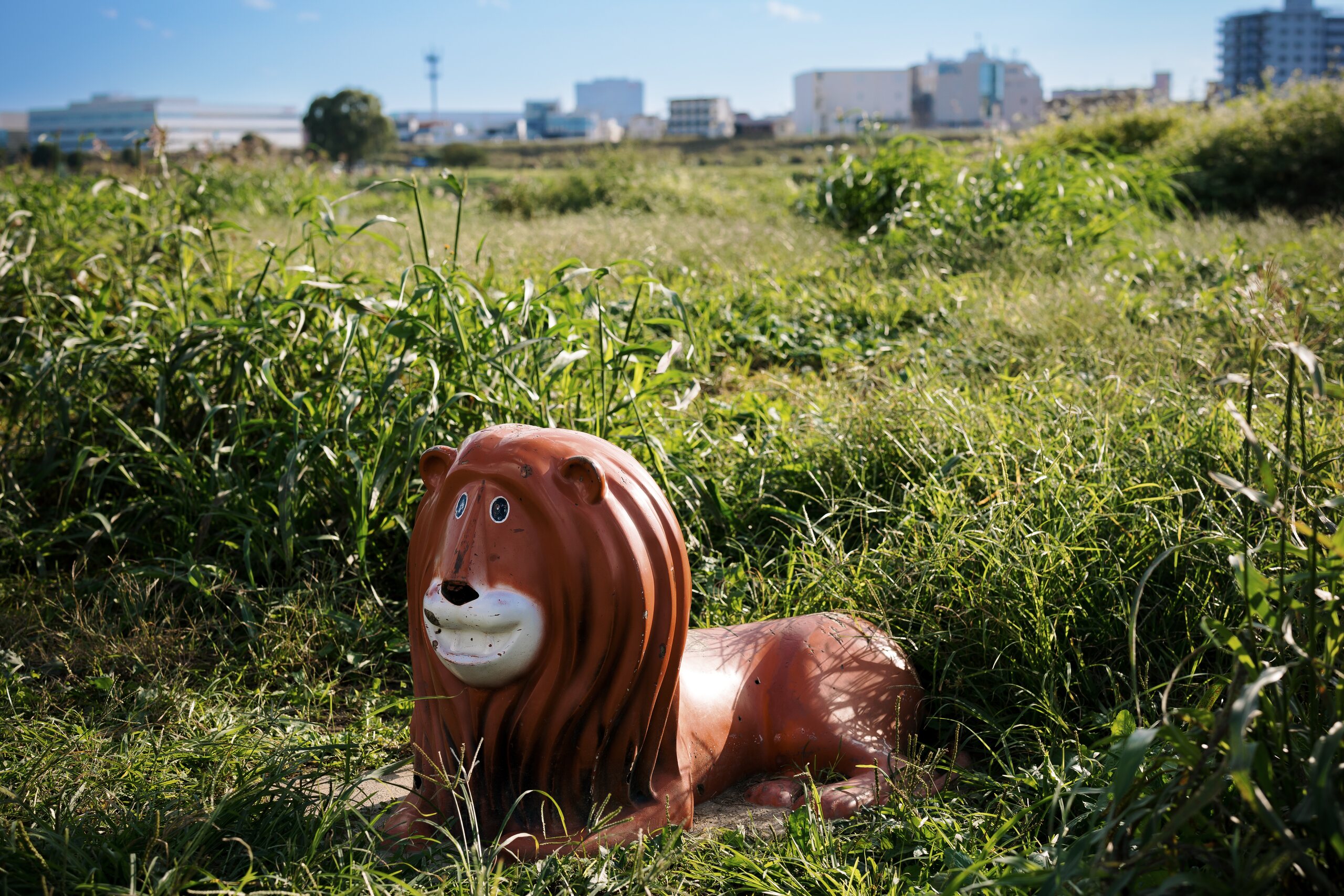
A lion lay in the grass beside the Tama River. He looked a little too gentle to be king of the beasts.
His reddish-brown mane rose above the vegetation. Behind him were apartment blocks, and power lines crossed the sky. The grass supplied a little wilderness. The apartment blocks kept the scene firmly in Tokyo.
This was Noge, in Tokyo’s Setagaya district, near the bridge carrying the Daisan Keihin expressway. The figure is known as the Lonely Lion, an old piece of playground equipment surrounded by very little that looks like a playground.
His front paws rested on a small exposed base, while the rest of his body stretched back into the plants.
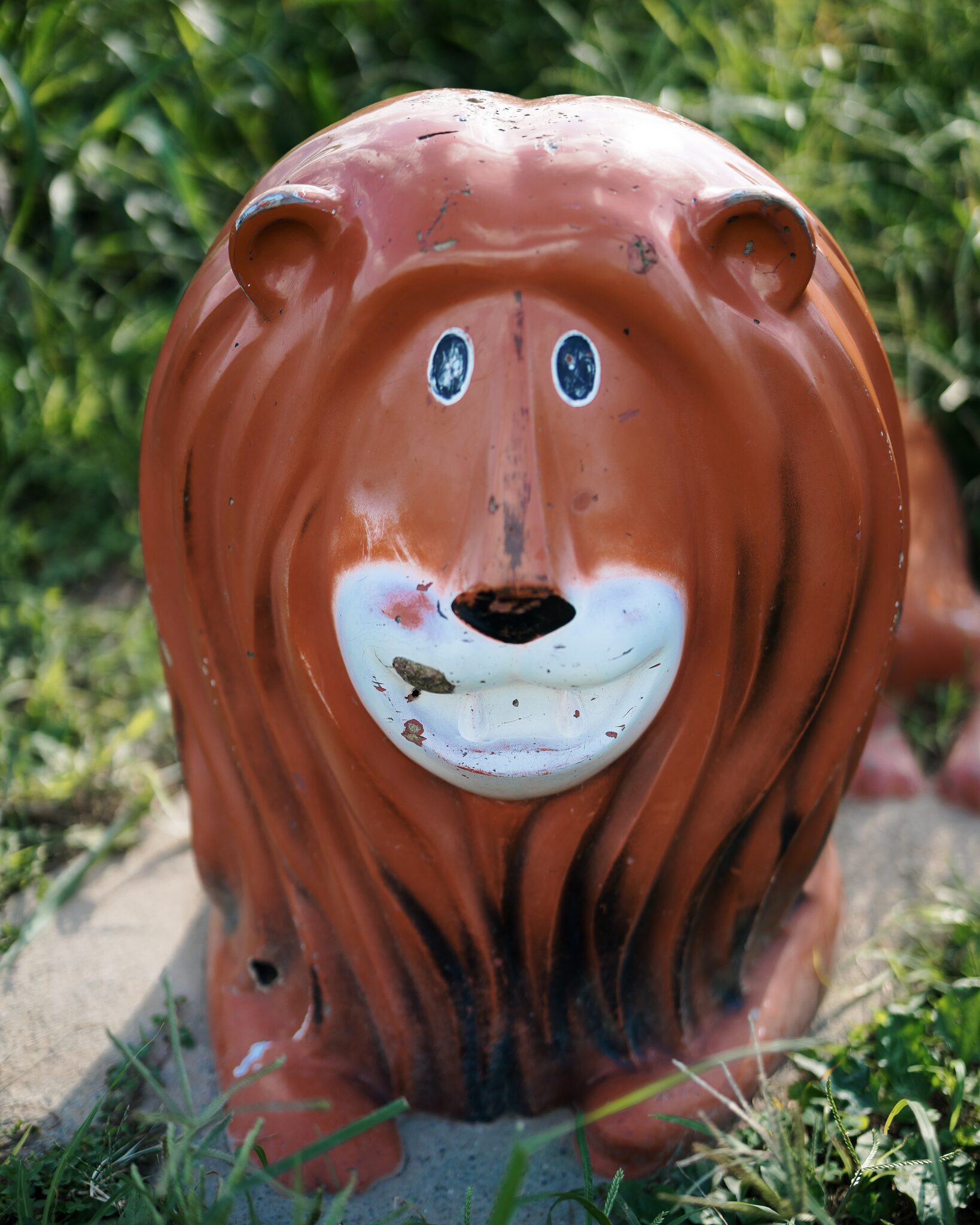
He had not always lived up to the name “Lonely Lion”.
A little company
In a photograph taken in 1984, a child sits on the lion’s back. Another photograph shows a panda nearby. The child grew up. Nearly four decades later, her own child found the pictures in the family album and sent them to Hori, a writer for Daily Portal Z who had become curious about the solitary animal by the river.
More photographs followed, shared by other readers. The low concrete edge of a sandpit appeared, and so did something resembling a log. One black animal, first identified as the panda, was later identified as a camel. What now looked like one lion in a field had once been a small collection of animal play equipment.
The family albums were proving unexpectedly useful as a wildlife census.
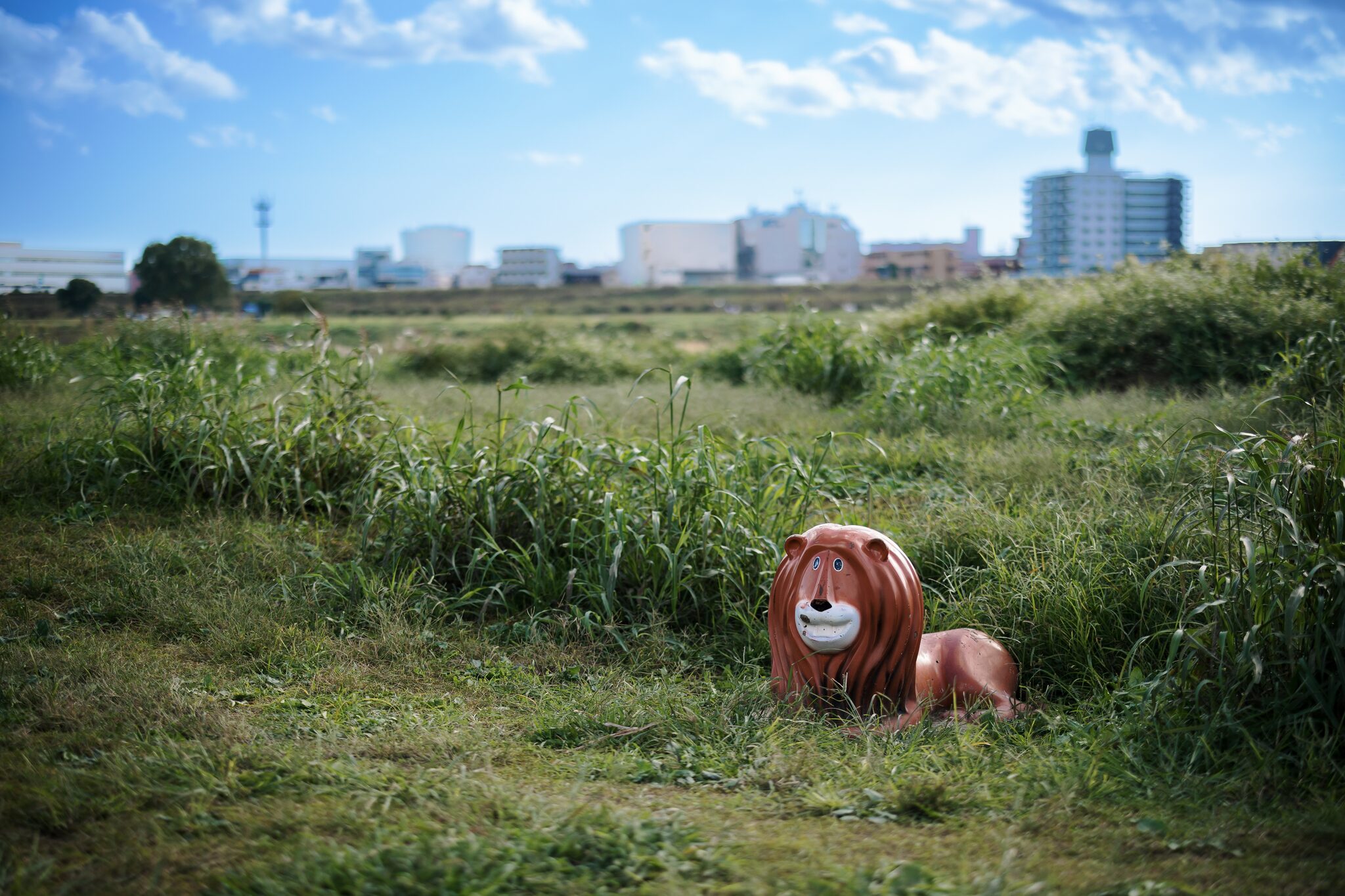
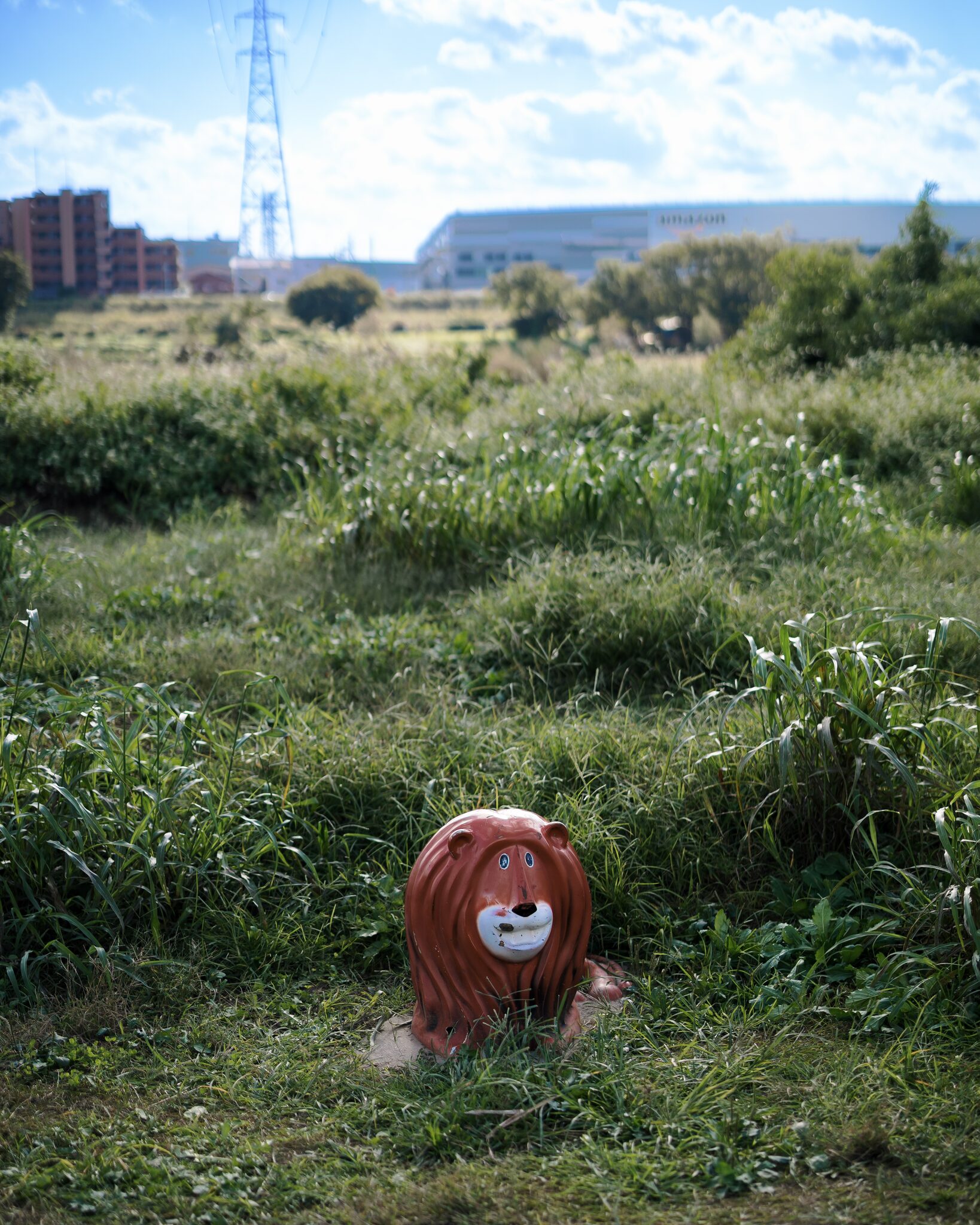
By the time I visited in November 2024, grass had reached the lion’s base and pressed close to his back. From a distance, he became a small red mark in a wide strip of green. Apartment blocks, an electricity pylon and the expressway bridge supplied the rest of the habitat.
Once the old photographs have shown you the panda and camel, the empty grass no longer looks entirely empty. It becomes the place where the others had been.
The trouble was that nobody could say exactly where they had gone.
Looking for the panda
There was a reason to look down.
The lion himself had been buried by earth and sand after Typhoon Hagibis struck in 2019. If one animal had survived underground, it was possible to wonder whether his former neighbours were still down there too.
Family albums had supplied a panda; locating the original would take an excavator.
Hori asked the park office whether he could dig. Digging holes in the park, he was told, was generally not allowed. The park office then arranged an excavation of its own. Hori had pictured staff with shovels. A contractor arrived with a hydraulic excavator, which uncovered part of the old concrete border around the sandpit, allowing the search to move towards the places where the animals were thought to have stood.
Neither panda, camel nor log emerged. No foundations were found either. The conclusion was that the missing equipment had probably been removed completely, perhaps after being damaged by debris carried in a flood. The precise story remains unknown.
Around the lion, workers dug carefully by hand and exposed his base. The only animal whose location was certain received the most delicate treatment.
The excavation recovered part of the playground’s outline, but none of its population.
For the park office, this was the good outcome: foundations left behind without their animals would have been a management problem. The head of the office was relieved, and considerate enough to suggest that readers might feel otherwise.
There is something slightly strange about reconstructing a playground from family photographs and buried concrete. The people who played there are still around. The panda is the one who has vanished without leaving a forwarding address.
Still facing the path
The search did not restore the old playground. It did, however, change what remained.
The lion was excavated and made visible again. A patch of ground that could easily have passed unnoticed now carried several layers at once: children climbing onto painted animals, a typhoon covering the last survivor, and adults returning with photographs and digging equipment to establish where a panda used to stand.
The excavation had not found him any company, but it had brought people to his feet. According to the head of the park office, the lion attracts a lot of enquiries.
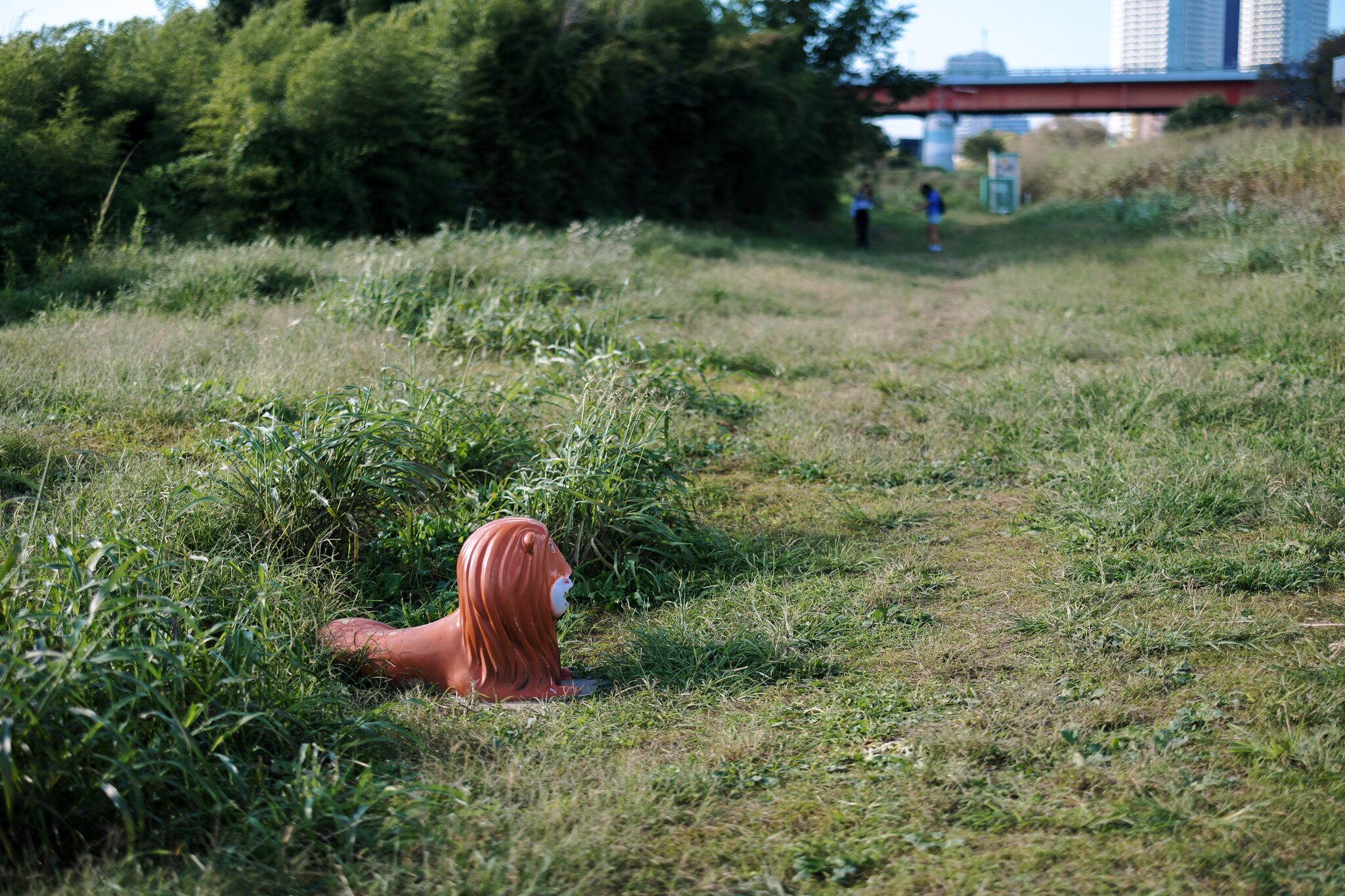
The lion still faces the path. His paint is worn, his concrete chipped, and grass continues to collect around him. He looks less like a monument than something that has simply declined to leave.
He has no known relatives, either. One reader believed the lion had been designed by their late father, an industrial designer at the playground manufacturer Masuset. The company compared him with its own products and suggested that his expression and the angle of his body were slightly different. Lookalikes reported in Kyoto’s Fushimi Inari area and at a housing-estate park in Nerima all turned out to be Masuset lions. Even his lookalikes belonged to another family.
The photographs matter because they alter the view. Without them, this is a red lion in an overgrown corner. With them, the grass becomes a missing playground, and the solitary figure becomes its surviving piece.
His kingdom had disappeared. The last king did not appear particularly troubled.
Visit this place
Location
Lonely Lion at Tamagawa Yuen (多摩川遊園の孤独なライオン)
In the riverside grass near the Daisan Keihin bridge
2-9 Noge, Setagaya-ku, Tokyo 158-0092, Japan
Practical Information
- Area
- Noge, Setagaya, Tokyo
- Access
- About 15 minutes on foot from Kaminoge Station or Futako-tamagawa Station, or about 2 minutes on foot from the Noge Nichome bus stop
- Admission
- Free
- Visitor note
- The lion stands in a grassy area beside the Tama River, near the Daisan Keihin bridge.
Information last checked: September 12, 2026
Conversation
Comments
Review pending commentsComments are reviewed before appearing. The internet already contains enough unattended surprises.
Checking comments…
Comments are not available in this migration preview yet. Existing comments remain on the current site.
Leave a comment